Every founder has a moment where the market starts saying out loud what you have been working on all along.
For me, that moment is now.
Over the last two years, we’ve had dozens of conversations with CEOs, investors, operators and boards about AI. The tone has changed.
A year or two ago, most conversations were about possibility.
“What could AI do?”
“Which tools should we test?”
“Should we run a pilot?”
Now the conversation is much more urgent.
“How do we get this into the business?”
“How do we make it safe?”
“How do we turn pilots into production?”
“How do we know whether it is actually creating value?”
That shift is why we are announcing QR/OS™. It’s how we’ve always been working, but now are making it formal.
The mid-market has a different AI problem
The U.S. middle market is one of the most important parts of the economy: nearly 200,000 companies, roughly one-third of private-sector GDP, and around a third of the employee base of the country.
These are the businesses that make, move, sell, service, finance, insure, distribute and operate huge parts of the economy.
But they are mostly stuck with AI.
These are companies too complex for off-the-shelf AI tools to transform the business by themselves. And they do not have the internal AI teams, governance structures, change capacity or endless budgets of the largest enterprises. Nor is it efficient for them to build that capability – and stay up with all the change in the world.
So what happens?
They run pilots.
They test tools.
They create a few impressive demos.
They buy licenses.
They form committees.
And then, too often, the work gets stuck somewhere between excitement and impact.
Not because the technology is weak.
Because transformation is hard.
AI has made the easy part easier — and the hard part more important
The last few years have made a lot of things dramatically easier.
Building a prototype is easier.
Creating content is easier.
Summarizing documents is easier.
Generating code is easier.
Standing up a chatbot is easier.
That is all real. It matters.
But it is not the same as redesigning work.
It is not the same as changing how a finance team closes the month, how a sales team qualifies demand, how a customer service team handles exceptions, how an operating team manages risk, or how a leadership team sees what is happening across the business in real time.
That is where the value is.
And that is where most organizations still struggle.
The next phase of AI will not be won by the companies with the most pilots. It will be won by the companies that can repeatedly turn AI into new ways of working.
QR/OS is our answer to that problem
QR/OS is the Quantum Rise Operating System.
Despite the name, it is not SaaS.
It is not another platform that gets dropped into the business and left for the client to figure out.
It is our repeatable system for AI transformation: a combination of people, software assets, governance, delivery methods and reusable building blocks that help companies move from AI experimentation to operational impact.
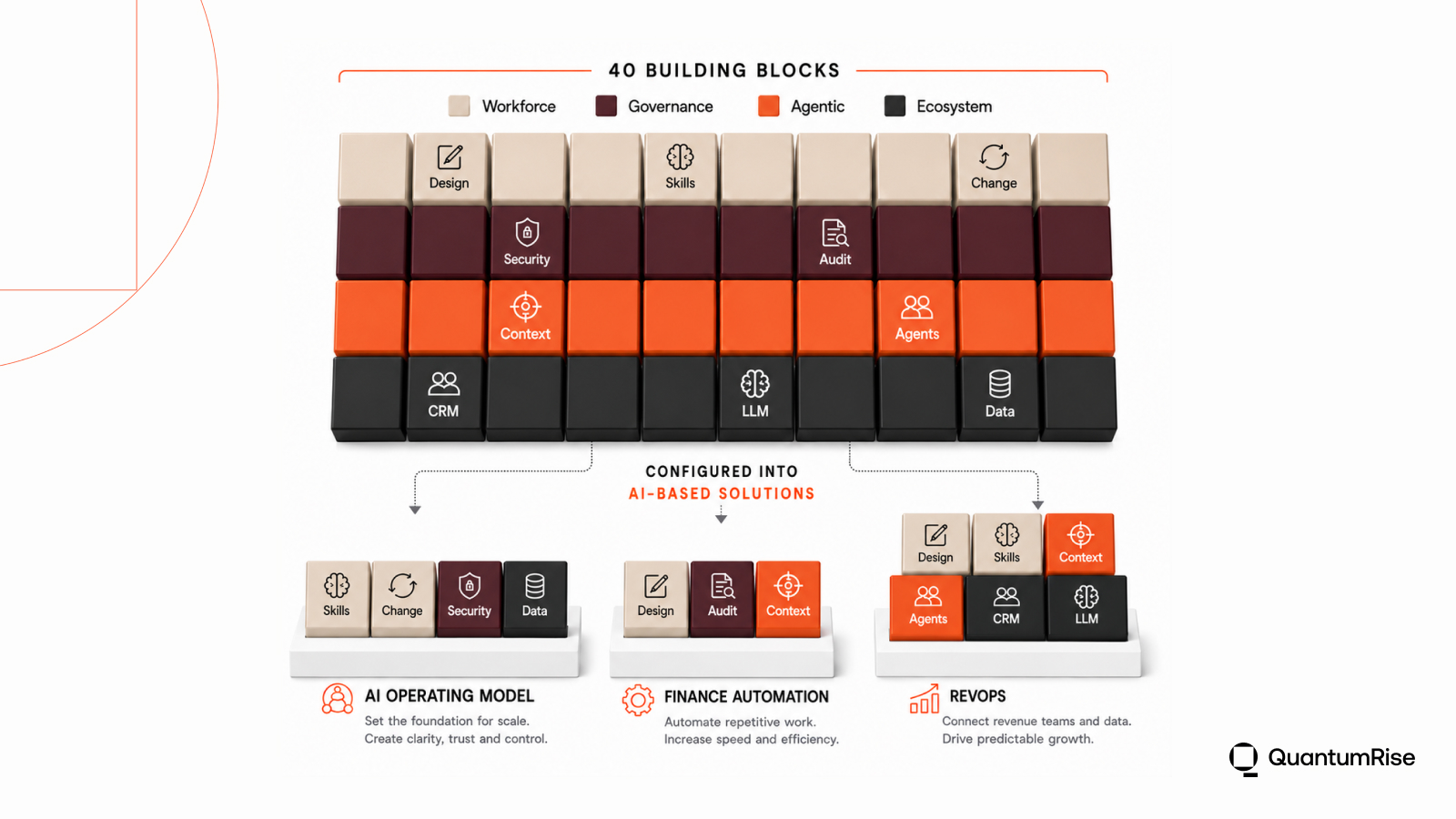
The image below is one way to think about it.
Each block represents something we have learned to reuse: a governance pattern, an agentic workflow, a data connector, a training model, a QA process, a dashboard, an integration pack, a change ritual, a deployment standard.
On their own, the blocks are useful.
Combined in the right way, they become outcomes.
An AI operating model.
A finance automation program.
A revenue operations engine.
A knowledge retrieval layer.
A workforce enablement program.
A control system for agentic AI.
The point is not the blocks themselves.
The point is repeatability.
Every company is different. But not every problem is unique.
The missing ingredient is control
There is a lot of noise in the market about AI acceleration.
Less attention is paid to AI control.
But in our work, control is increasingly the difference between a demo and a deployed system.
AI systems need governance.
They need evaluation.
They need security.
They need access controls.
They need human oversight.
They need testing, monitoring, escalation, cost management and accountability.
They need to be designed around the realities of the business, not just the capabilities of the model.
This is especially true as AI moves from “answering questions” to taking action.
Agentic AI raises the stakes.
If software is going to reason, recommend, trigger workflows, interact with systems and influence decisions, then businesses need much stronger control processes around it.
That cannot be an afterthought.
In QR/OS, governance is not a slide at the end of the deck.
It is one of the core layers.
We believe the next AI winners will be builders, not browsers
The first wave of enterprise AI was about access.
Can people use ChatGPT?
Can we turn on Copilot?
Can we test Claude?
Can we give teams tools?
That wave is useful, but it is not enough.
The next wave is about building.
Building new workflows.
Building new operating models.
Building new decision systems.
Building new human + machine teams.
Building measurable business outcomes.
That is why Quantum Rise exists.
Our promise has always been simple: outcomes, not PowerPoints.
QR/OS makes that promise more scalable.
It gives our teams a common language, a repeatable architecture and a set of reusable assets that allow us to move faster without pretending every client should get the same answer.
It gives clients a way to start practically, scale responsibly and keep improving over time.
And it gives mid-market companies something they badly need: a serious AI transformation partner built for their reality.
AI that works for you.
Not as a slogan.
As an operating system for the next chapter of business.




.svg)
